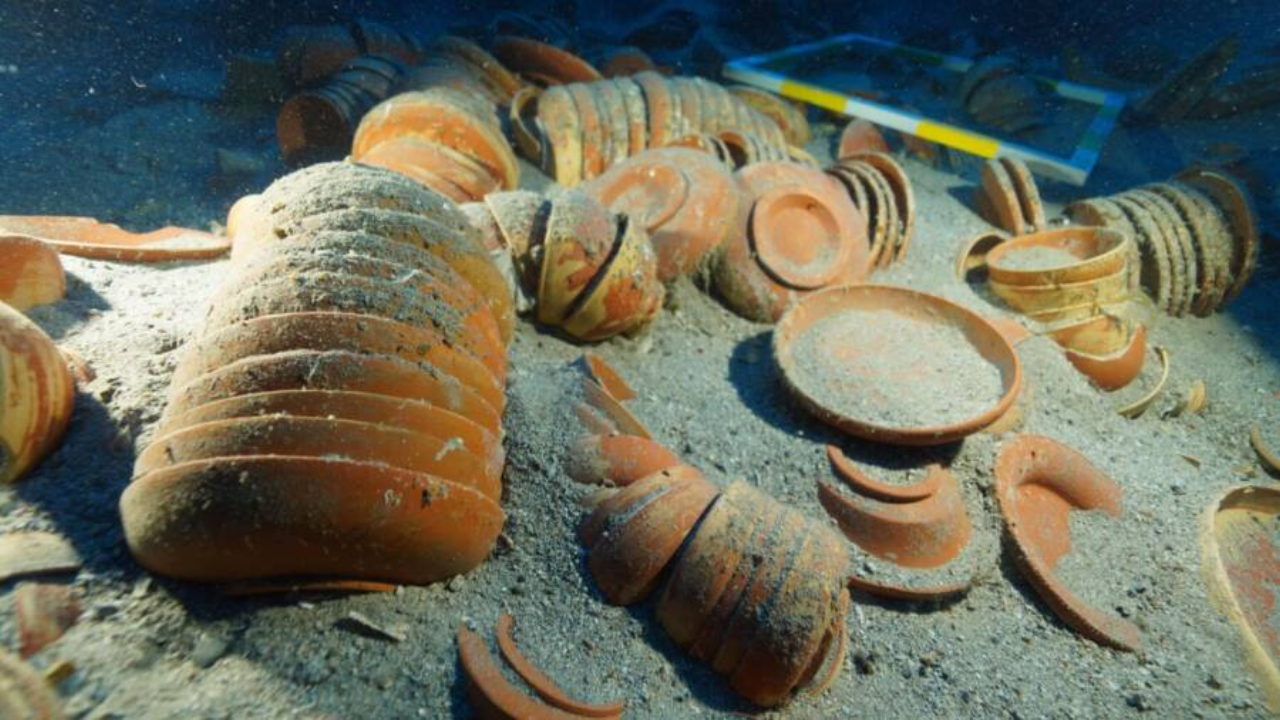
History usually speaks through grand monuments and royal decrees, but sometimes it arrives in crates of broken pottery. Off the Turkish coast near Adrasan, marine archaeologists recently pulled something extraordinary from the Mediterranean floor. It is a 2,100-year-old cargo ship that sank while bound for Rome, packed to the brim with thousands of ceramic plates, bowls, and serving dishes.
What makes this find extraordinary isn't just the scale of the cargo. It's the sheer variety. Divers and underwater robotic systems working at depths between 140 and 18 feet cataloged 122 distinct types of tableware. This is a massive haul that offers a rare, granular look at ancient mass production and dining culture during the Late Hellenistic and Early Roman periods.
Even more fascinating is that this exact style of high-end crockery was famous enough to be immortalized in writing over two millennia ago.
The Clay That Cicero Wished For
For decades, scholars debated the exact origins of a specific brand of elite tableware mentioned by Roman writers. The source was traced back to Rhosus, an ancient port city in modern-day Arsuz, Turkey. Back then, Rhosus was a bustling hub for high-end ceramics.
How famous was it? Famous enough that the Roman statesman and orator Marcus Tullius Cicero wrote about ordering it. In a letter written around 50 B.C.E. to his close friend Titus Pomponius Atticus while serving as governor of Cilicia, Cicero explicitly noted that he had ordered Rhosica vasa—dishes straight from Rhosus.
Historians spent centuries trying to pin down the physical proof of these legendary pieces. Some experts argued they belonged to a category known as Eastern Sigillata A, popular clay tableware originating near the Gulf of İskenderun. This newly excavated shipwreck provides the concrete, physical evidence researchers needed to bridge the gap between Cicero's letters and actual archaeological remains.
How Ancient Mariners Kept Cargo Safe
Finding thousands of pieces of ancient pottery intact is nearly unheard of. Normally, centuries of crashing waves, shifting seabed currents, and tectonic activity turn cargo holds into fields of worthless shards.
This crew survived intact thanks to an ancient packing technique. Archaeologists discovered that the Roman merchants packed clay between individual ceramic pieces before placing them into shipping crates. That layer of cushioning absorbed the shock of the open sea. It kept the plates from grinding against each other during rough Mediterranean storms.
That simple logistical choice saved the cargo from destruction. It also gave modern scientists an undisturbed time capsule of how trade actually operated two thousand years ago.
Turkey's Minister of Culture and Tourism, Mehmet Nuri Ersoy, announced that excavations on the site began in 2025. Since then, experts have transferred thousands of recovered ceramic pieces to the Antalya Museum and specialized conservation labs.
A Thriving Maritime Highway
This discovery isn't an isolated anomaly. The waters off the Turkish coast are a graveyard of ancient commerce, acting as a massive underwater archive of the Mediterranean's economic engine.
Other recent finds in the region include a 1,500-year-old wreck carrying 10,000 ceramic plates, alongside an 11th-century ship that went down with jugs of olive oil still sealed inside. Each wreck tells a different story about supply chains, consumer habits, and the sheer volume of goods moving across the ancient world.
We may never know who placed the multi-thousand-piece order on this particular doomed vessel, or whose dining room table those 122 varieties of tableware were meant to grace. But as conservationists clean the clay packing away from plates molded over two millennia ago, we get a front-row seat to the daily luxury of the ancient Roman elite.